Active hope: a commitment to the relentless search for possibility
In times of crisis, practicing active hope is a survival strategy. This collection is designed for those who believe in this everyday practice of imagination, collective agency, and mutual care, capable of keeping the possibility of change alive.
Start getting inspired by discovering this series of content:
Explore why active hope is not naïveté, but a political strategy to find possibilities even in adverse scenarios.
Learn to transform fear into shared courage and to sustain collective action in order to move toward horizons that mobilize.
Enjoy this space to learn and let yourself be inspired by those who are already weaving other worlds.
Explore at your own pace
How much time do you have today to explore this collection?
If you have 10 minutes: A spark of inspiration
We bring a proposal:
Let’s practice active hope to find where possibility lies. But what does this mean?
In a time marked by fear, cynicism, and the feeling of permanent collapse, we seek to advance a different story: one that recognizes the darkness without paralyzing us and reminds us that we can still transform the world. One that affirms that hope is neither naïveté nor evasion, but a collective practice capable of transforming fear into fuel, rage into political energy, and critique into compost for new futures.
This narrative is not only told; it is rehearsed every day. It invites us to identify the cracks where other forms of life are already germinating, to imagine irresistible horizons that guide our path, and to recognize that deep change can only happen in community.
Our Executive Director Mónica Roa puts it this way:
“Active hope does not ignore pain or soften it: it recognizes it, processes it, resignifies it, and turns it into fertile ground where new worlds can germinate.”
Active hope: a survival strategy
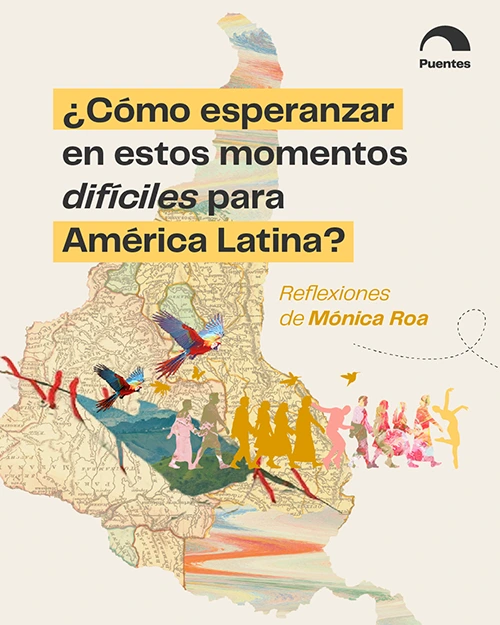
In this video, our Executive Director Mónica Roa López shares with us why we need an everyday practice of imagination, collective agency, and mutual care, capable of keeping the possibility of change alive.
Get inspired by her words and share them with your colleagues.
If you have between 20 and 30 minutes: A moment to spark ideas
Key points to keep weaving:
Active hope: the commitment to walk toward what is possible
We are living through multiple crises that generate anxiety, uncertainty, and deep questions about the future. That is why we know we need alternatives that allow us to resist cynicism and inaction.
Active hope is proposed as a survival strategy: a way to be clear about the starting point, visualize where we want to go, and move forward collectively, step by step, keeping the search for possibilities alive. It is a powerful and mobilizing idea. Its strength lies in acting, not in waiting.
There are 4 key elements to understand active hope:
An unbearable reality
Reality becomes so difficult to hold that it pushes us to search for meaning. This discomfort, though painful, is also fertile: it is the ground where a new perspective can germinate.
An irresistible vision
We need to create a vision of what the world would look like if our causes florished. A mobilizing utopia that lights up imagination and the heart, and that is so compelling it reminds us why it is worth continuing to walk, even in the midst of an unbearable context.
Collective agency
It is important to recognize our agency: the capacity to act in order to transform the course of events. To do so, each person must contribute from what they know, what they can do, and what they dream of. By taking on diverse roles and intertwining them in a common direction, we weave a network that sustains the momentum for change over time.
The commitment to the relentless search for possibility
Active hope is something practiced every day. It means making the constant decision to search for possibility and asking ourselves: what can I do, from this reality that seems unbearable, to build a path, step by step, toward that irresistible vision of the future?
Between cynicism and courage: uncomfortable reflections on active hope
Talking about active hope in a context where we see the rise of authoritarianisms and climate, social, humanitarian, and ethical crises is uncomfortable but necessary. Naming it before those who live these realities in all their harshness demands honesty from us.
In these complex contexts, questions like these will surely arise: How can we call on hope without making it sound naïve and without making it seem like an insult to our pain? How can we talk about hope without diminishing the seriousness of our struggles? That is why we must remind ourselves that hope is not a passive feeling, but a discipline. A commitment to collective action sustained over time, one that requires recognizing fear and vulnerability, but also courage and collective agency.
We need a hope that practices political composting: one that takes the rot of the world, processes it, and turns it into compost for dignified futures. A hope that sustains spaces where we can meet, imagine ourselves, and accompany one another as we drive change, even when we do so from fear, exhaustion, or joy. Practicing it is a radical act of care and possibility.
Para ampliar tus referentes te recomendamos explorar
bell hooks
Writer, historian, and activist.
Recommended book:hooks, bell. Teaching Community: A Pedagogy of Hope. New York: Routledge, 2003.
Thomas Coombes
Communications expert and human rights advocate. He designed hope-based communications.
If you have more than 30 minutes: A journey to the heart of narrative work
Lighthouses of Interconnectedness
Go deep into this collection guided by our Director Mónica Roa
Active hope: the commitment to walk toward what is possible
In the face of crises that generate anxiety and uncertainty, active hope emerges as a strategy to move step by step toward what is possible, acting instead of waiting. It rests on four keys: recognizing the unbearable reality, imagining an irresistible vision, activating collective agency, and practicing the search for possibilities every day.
Between cynicism and courage: uncomfortable reflections on active hope
Talking about active hope amid authoritarianisms and deep crises is uncomfortable, but indispensable, because it is not about naïveté, but about a discipline that combines vulnerability, courage, and collective action. In the face of fear and pain, we need a hope capable of transforming the world’s problems into compost for dignified futures, sustaining spaces of encounter, imagination, and accompaniment.
Between cynicism and courage: uncomfortable reflections on active hope
Watch out for the traps of hope!
Soothing placebo Hope as a fantasy that calms anguish without transforming reality. If it is built by denying fear, it falls into forced optimism.
Anxiety over immediate results Believing that hope only exists when there are clear signs of victory.
Empty or incomplete declaration Naming hope without practicing it in everyday life turns it into rhetoric. Active hope must be rehearsed in the present.
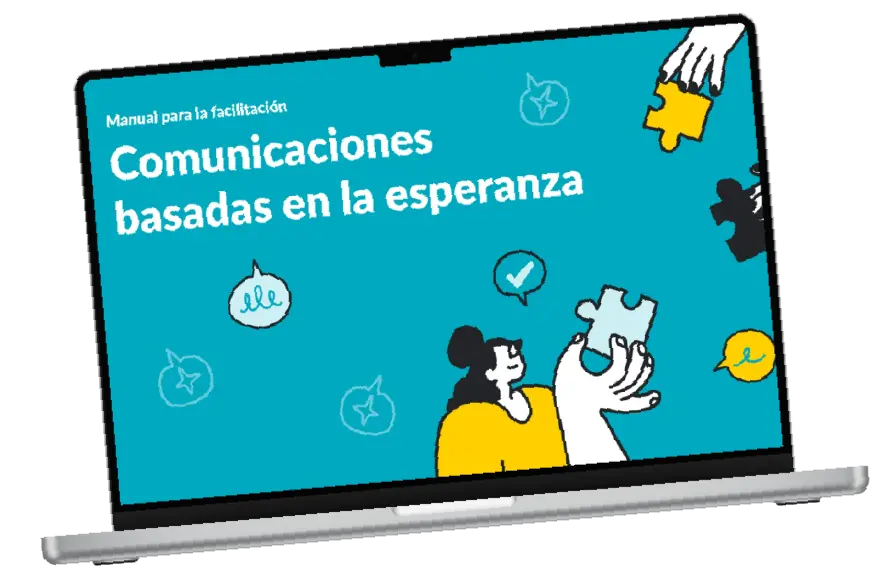
Manual for the Facilitation ofHope-Based Communications.
Created by Thomas Coombes and shared in the Inspiratorio, our training space in narrative power, this manual is a practical tool to plan and facilitate hope-based communications workshops. It is designed to accompany organizations and collectives as they build their own approach and strategy from hope.
Here you will find the foundations for introducing the five hope-based narrative shifts, with guidance to put them into practice in spaces of training, reflection, and strategic design.
By sharing this manual, we seek to help more change agents strengthen the narratives they want to advance and integrate them into their communication plans.