This collection is designed for those who seek to expand the limits of what is possible and reconfigure the stories that define our future today and make it seem inevitable.
Get inspired:
Explore how radical imagination can open horizons and become a key tool for building narratives that expand what we believe is possible.
Learn to identify and transform the metaphors that organize our way of understanding the world.
Get inspired by reflections and resources to reimagine tomorrow, practice the future, and build irresistible visions that mobilize change.
Explore at your own pace
How much time do you have today to explore this collection?
If you have 10 minutes: A spark of inspiration
We bring a proposal:
Let’s use radical imaginationto start building the future. But what does this mean?
The future is not a place we arrive at: it is a story we are telling all the time. And today, many of those stories already come shaped by narratives that reduce what is possible, repeat crisis as destiny, and make us feel that there is no alternative.
That is why contesting imagination is an urgent task: because it invites us to break those limits and proposes that we stop merely reacting to the present and begin rehearsing futures. It is necessary to practice, in everyday life, the relationships, decisions, and ways of living that we want to see flourish.
It is about imagining in order to transform. About building irresistible visions that not only give us meaning, but also invite other people to walk in that direction.
Betting on radical imagination means daring to create futures that do not yet exist, but that are already beginning to take shape in the way we name them, share them, and make them possible collectively.
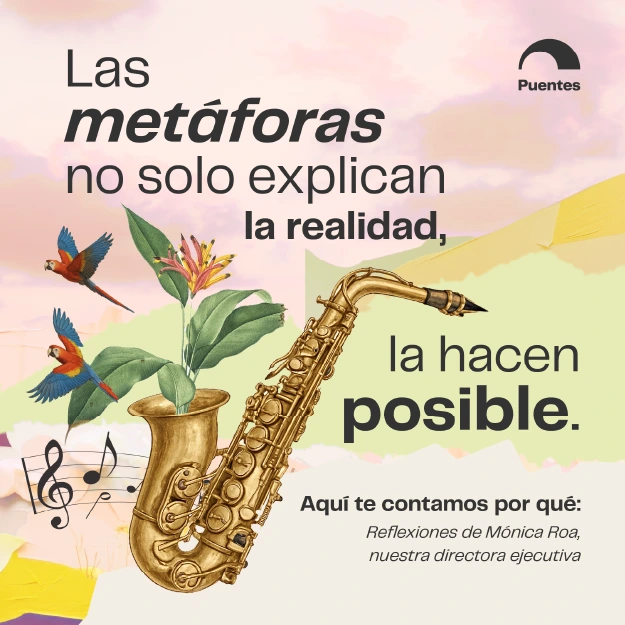
We share with you reflections from our Executive Director Mónica Roa López on the metaphors we use from within our social movements. We also tell you what the “jazz band” metaphor represents when describing our work.
If you have between 20 and 30 minutes: A moment to spark ideas
We bring you a proposal
Go deep into this collection guided by our Director Mónica Roa
Disputing imagination or losing the future
In a world where certainties blur and uncertainty grows, the dispute is no longer only over political power, but over the power to imagine.
Authoritarianisms reduce what we believe is possible, narrowing our horizons and weakening collective desire. In response, radical imagination emerges as a political practice: a way to keep the future open, rehearse new metaphors, and create stories that expand what is possible and mobilize others. But it does not happen on its own: it needs spaces, time, and collaboration to become a real force for transformation.
Cultivating this imagination is a form of survival. It means training ourselves collectively to read the present without becoming trapped in it, rehearse futures in everyday life, and sustain narratives that expand what is possible. Because imagining differently is the beginning of transforming reality.
The metaphors that organize us
So, while movements were moving forward in parallel, often fragmented, authoritarian forces were reorganizing the terrain by contesting imagination and redefining what was possible. The consequence was not only political, but narrative:
our stories stopped resonating and our collective imagination weakened. To recover that pulse, the challenge is to build narrative power capable of transforming discourses deeply rooted in common sense.
We propose one concrete key: the metaphors we use are not neutral; they organize how we understand the world and how we act in it. When we operate from warlike frames (“communication battles, fronts of action, trenches,” etc.), we reproduce logics of conflict that contradict the values of care, interdependence, and collaboration that we seek to sustain. That is why contesting imagination also means transforming the metaphors that organize us.
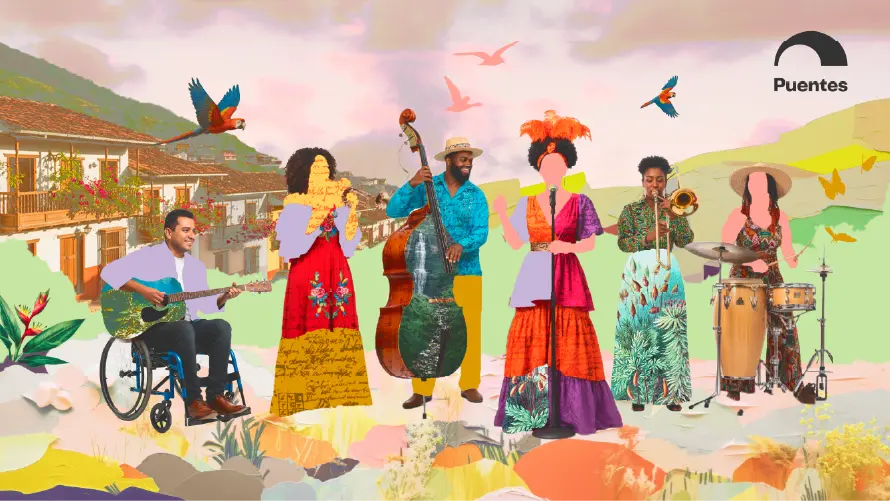
From there, the jazz band metaphor emerges as a way to reimagine collective action: a practice based on shared agreements, improvisation, listening, and fluid leadership. This image has allowed us to understand narrative power as a living coordination, where diversity is not eliminated but harmonized. Resonating collectively, then, is a political decision to build a “larger we,” capable of sustaining and expanding possible futures.
Practicing the future
Narratives do not only operate outwardly, as messages meant to persuade, but also inwardly: they organize how we understand our collective action, what we believe is possible, and how we sustain our causes over time. That is why transforming narratives is not only a discursive exercise.
At Puentes, we repeat it clearly: narratives do not change simply by explaining them. They must be embodied. It is not enough to talk about a different world. We must begin to practice it.
This means creating experiences where those narratives are lived. Spaces to rehearse the future in the present, explore other ways of being, feeling, and acting, and strengthen the human fabric that makes collective action possible. From there emerge our digital resonances: virtual gatherings that combine art, emotion, and connection to sustain bonds, process pain collectively, and activate a “larger we” capable of facing uncertainty.
These resonances are our micro-political experiments: concrete ways of practicing the world we want to build while it is still taking shape. They do not replace traditional political action, but they do something just as urgent: sustain the care, imagination, and connection that allow our causes to endure. Because the future is not only named or denounced. It is also rehearsed.
Tomorrow reimagined
Imagining the future does not mean inventing it from scratch, but learning to identify those stories that already exist and illustrate the future we would like to see. It is not about writing perfect utopias, but practicable horizons that we can begin rehearsing from the present with our communities.
Exercises in radical imagination are incomplete and imperfect. And precisely because of that, they must be released into the world: as open invitations for other people to read them, nourish them, and expand them. Because imagining the future is not an individual act, but a collective exercise that invites us to play, explore, and take risks.
Let us remember: dreaming demands political lucidity, and imagining other possibilities is not escaping the present, but committing ourselves to the futures already pulsing within it.
To expand your references, we recommend exploring
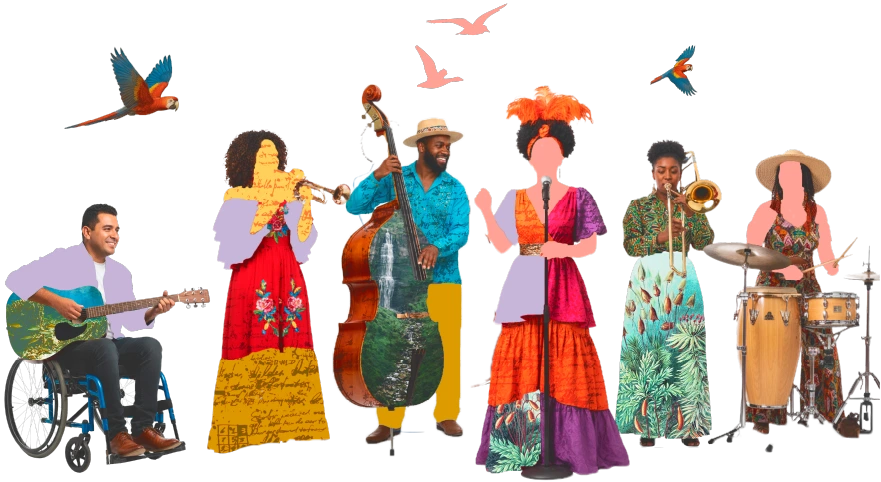
At Puentes, we have spent several years exploring the “jazz band” metaphor to think about how narrative power is built collectively, flexibly, and in a distributed way: without a conductor and without rigid scores, improvising from a shared harmony in order to coordinate, listen to one another, and respond to complex contexts.
That is why we decided to collaborate with a Latin American jazz band and create a series of four short videos that bring to life the main components of this metaphor and the questions we have been exploring.
If you have more than 30 minutes: A journey to the heart of narrative work
Lighthouses of Interconnectedness
Go deep into this collection guided by our Director Mónica Roa
Disputing imagination or losing the future
When the compass breaks, we do not only lose our way: we risk accepting that someone else will define what is possible. This text invites us to understand how authoritarianisms contest imagination, why building narrative power is an urgent political task, and why imagining is also a way to survive and transform the present.
The words we use to organize ourselves are not neutral: they shape how we think, act, and relate to one another. This blog proposes leaving behind the frames of war and exploring new forms of coordination grounded in listening, improvisation, and co-creation. Explore the full text and discover how the “jazz band” metaphor can help us imagine a “larger we.”
If we want to change narratives, it is not enough to explain them: we need to embody them. This text shows us how the future is rehearsed through concrete practices, such as digital resonances: Puentes’ virtual gatherings where we experiment with new forms of connection, care, and collective action. Read the blog and explore how to begin living today the world we want to build.
Through a story that places us in a possible future, this blog invites us to feel what other ways of living, organizing ourselves, and caring for one another could be like. Reimagining tomorrow is not an abstract exercise, but a practice that begins by identifying the everyday stories that already exist and projecting them into the future. Read the full text and let yourself be carried by a story that expands what we believe is possible and transforms what we consider desirable.
In this virtual event, we made musical magic and explored a powerful idea: narrative work is a coordinated improvisation like that of jazz bands. A living act where each story contributes from its singularity and, even so, builds a common harmony.
We learned that resonating collectively is a political act:
It is choosing collaboration over competition,
connection over isolation,
joy over fear.
It is weaving a common harmony,
complementing our singularities,
connecting with our audiences,
and transforming our music into the energy that sustains us